

Shopify Marketing Strategy: The Complete 2026 Guide
Most Shopify stores don't have a traffic problem. They have a conversion problem. Build the connected system: SEO, paid ads, email, and social.
Most Shopify stores don't have a traffic problem. They have a conversion problem. Visitors land, browse for 90 seconds, and vanish like they were never there. The gap between eyeballs and revenue is where strategy lives, and most store owners skip straight to tactics without building the system underneath. A coherent Shopify marketing strategy closes the gap.
This guide walks you through a full Shopify marketing strategy for 2026, step by step. Whether you crossed your first $10K month or you're pushing toward seven figures, you'll leave with a framework to execute this week. By the end, your core channels connect: organic search, paid ads, email, and social. More important, you'll see how each channel feeds the next instead of operating in isolation.
Before You Start
A Shopify marketing strategy needs four things in place before step one. You don't need a big budget or a marketing degree. You need a foundation strong enough to survive your first traffic spike.
- A live Shopify store with at least one product ready to sell.
- Google Analytics 4 and the Meta pixel installed.
- A rough sketch of your ideal customer.
- An email platform connected to your store. Klaviyo and Mailchimp are the usual picks.
Got all four? Good. Let's build.
Step 1: Nail the Foundation
Tactics without positioning are noise. Every Shopify marketing strategy rests on the two pieces below. Lock them down before you spend a dollar on ads or publish a single post. Every decision downstream depends on them.
Define Your Customer (For Real This Time)
Skip the demographics worksheet. Read your last 20 customer reviews and support tickets instead. What language do buyers use? What problem sent them searching? Their words become your marketing copy.
Then write down the single biggest frustration your product solves. Not three frustrations. One. Sharper focus, harder-hitting message.
Track Metrics With Teeth
Vanity metrics feel good and mean nothing. Your follower count won't pay your supplier. Watch four numbers instead, weekly, not monthly. Monthly reporting lets problems fester.
- Blended CAC. True cost to acquire a customer across every channel. Target for $1M to $5M brands: under 30% of AOV.
- Contribution margin. Profit after COGS and marketing spend. Target: 20 to 40%.
- Email revenue share. Revenue from owned channels versus paid. Target: 25 to 40% of total.
- Returning customer rate. Repeat purchases signal product-market fit. Target: 25% or higher for consumables.

Step 2: Build an Organic Engine
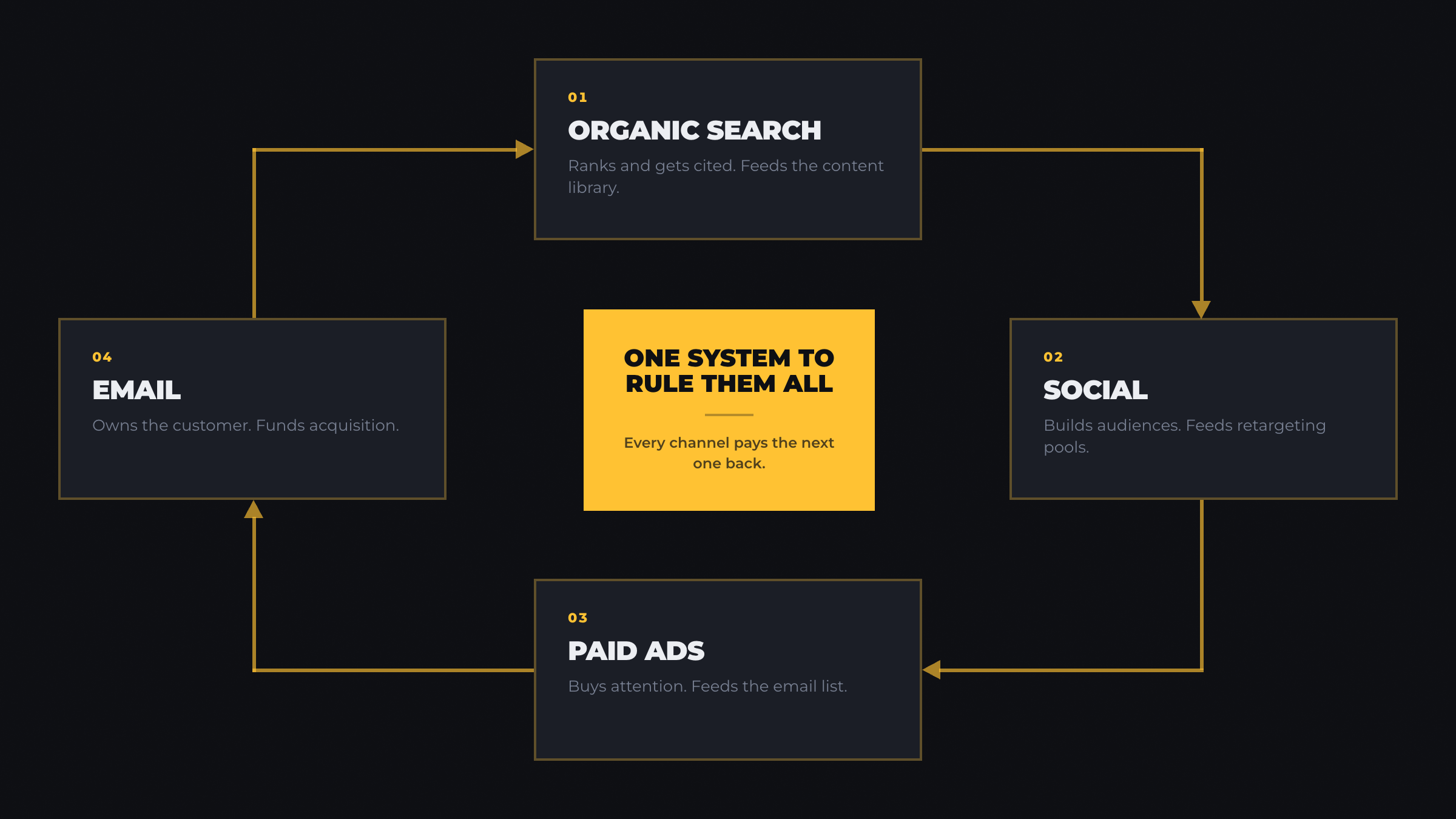
Paid ads are a faucet. Money in, traffic out, and everything stops the moment you turn them off. Organic search works like a flywheel. Slow to spin up, then every piece of content makes the next one work harder. Organic search gives your Shopify marketing strategy a compounding asset instead of a rented one.
In 2026 the flywheel has two halves: ranking in Google, and getting cited by AI assistants like ChatGPT and Perplexity. Same engine, two outputs.
Shopify SEO Basics
Shopify handles a chunk of technical SEO out of the box, genuinely one of the platform's strengths. The platform won't write your product descriptions, optimize your collection pages, or build a content plan. Start here:
- Write unique product descriptions. Never paste manufacturer text.
- Optimize collection page titles and meta descriptions around buyer-intent keywords.
- Add descriptive alt text to every product image.
- Publish at least two posts per month targeting long-tail keywords your customers search.
One caution: don't obsess over technical audits while your store has 15 products and zero posts. Content first. Fine-tuning later.
Get Found in AI Search
More buyers now start with a question in ChatGPT instead of a search bar. Your future customer asks "best [category] for [use case]" in a chat window and buys from whoever the answer names. AI assistants cite sources with clear structure: direct answers, FAQ blocks, specific numbers, and pages proving who you are. Write for the question, answer in the first two sentences, then go deep. The same habits lift your Google rankings too.
Pick Topics Buyers Search
Not all blog traffic converts. A post titled "What Is [Your Category]?" attracts browsers. A post titled "Best [Category] for [Specific Use Case]" attracts buyers. Prioritize the second type, aggressively.
Map your calendar to launches and seasonal peaks. Selling outdoor gear? Summer content goes live in March, not June.
Step 3: Run Paid Ads Without Burning the Budget
Store owners torch cash here faster than anywhere else. Promote a post, watch traffic spike, celebrate, then check the bank account a week later and wonder where the money went. Paid ads accelerate a working Shopify marketing strategy. Paid ads also expose a broken one, fast.
Meta or Google First?
The honest answer: depends on the product.
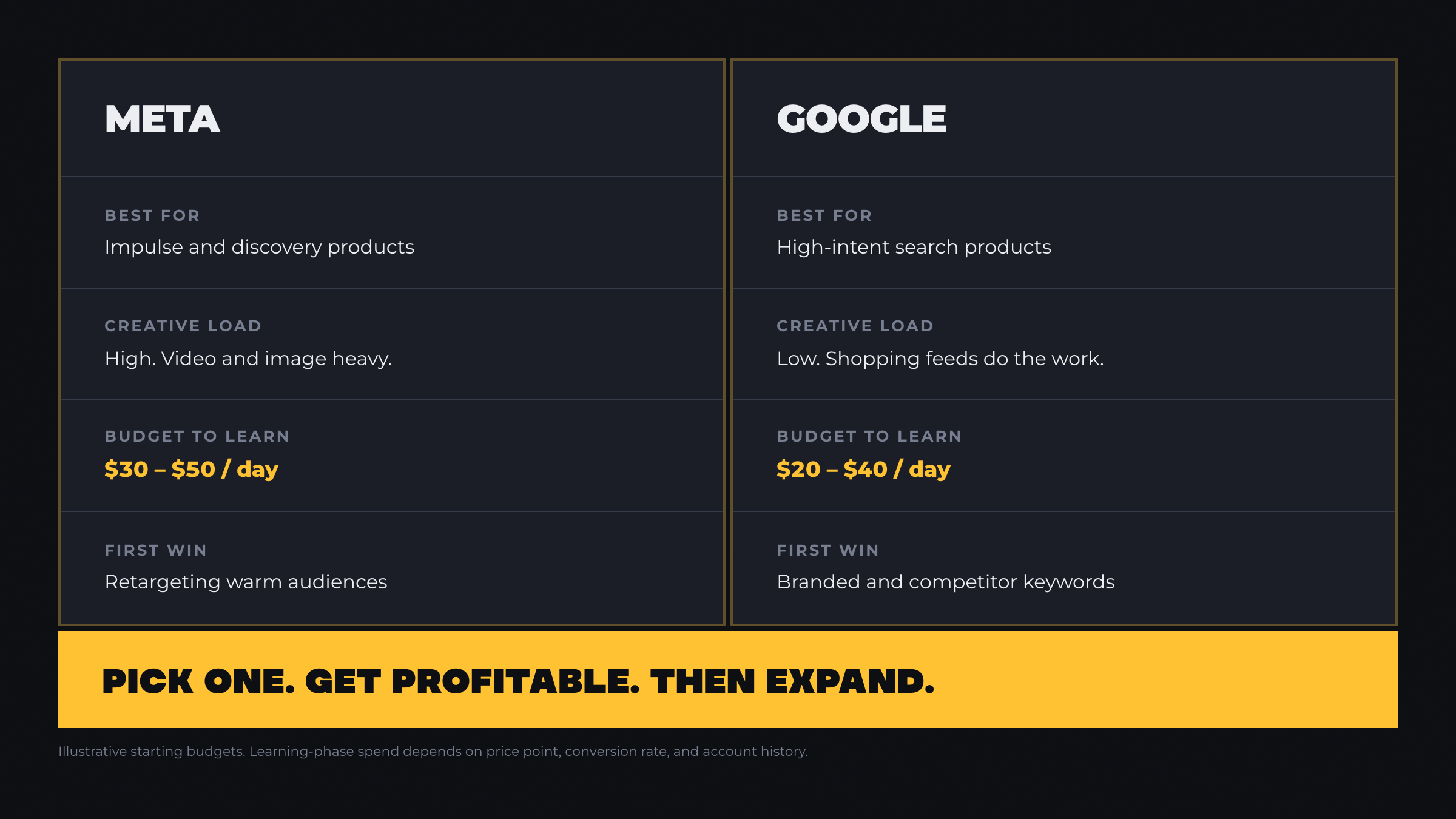
- Meta (Facebook and Instagram) wins for impulse and discovery products. Creative demands run high, video and image heavy. Budget to learn: $30 to $50 a day. Best early win: retargeting warm audiences.
- Google wins for high-intent search products. Shopping campaigns are the easier entry, Search has the steeper curve. Budget to learn: $20 to $40 a day. Best early win: branded and competitor keywords.
People actively Google your product ("best waterproof hiking boots")? Start with Google Shopping. Your product triggers impulse buys on sight ("hand-poured candles with custom labels")? Meta is your playground.
Don't split a small budget across both platforms. Pick one, learn deeply, get profitable, then expand. Spreading $50 a day across two platforms teaches you nothing about either.
Retargeting: Money on the Table
About 97% of first-time visitors won't buy. Normal. Letting them disappear forever? Not normal. Set up Meta retargeting for anyone who viewed a product page without purchasing. This campaign almost always posts the highest ROAS in your account.
Keep the window between 7 and 14 days for most products. Longer windows waste money on people who moved on.
Step 4: Make Email Your Highest-ROI Channel
Email isn't glamorous. Nobody brags about their welcome sequence at dinner. But a well-built email system routinely drives 25 to 40% of total revenue for Shopify stores, and you own the channel outright. No algorithm decides who sees your message. Email turns a Shopify marketing strategy into owned revenue.
The Four Flows Every Store Needs
Forget the 20-email sequences. Start with four automated flows and dial them in before adding anything else.
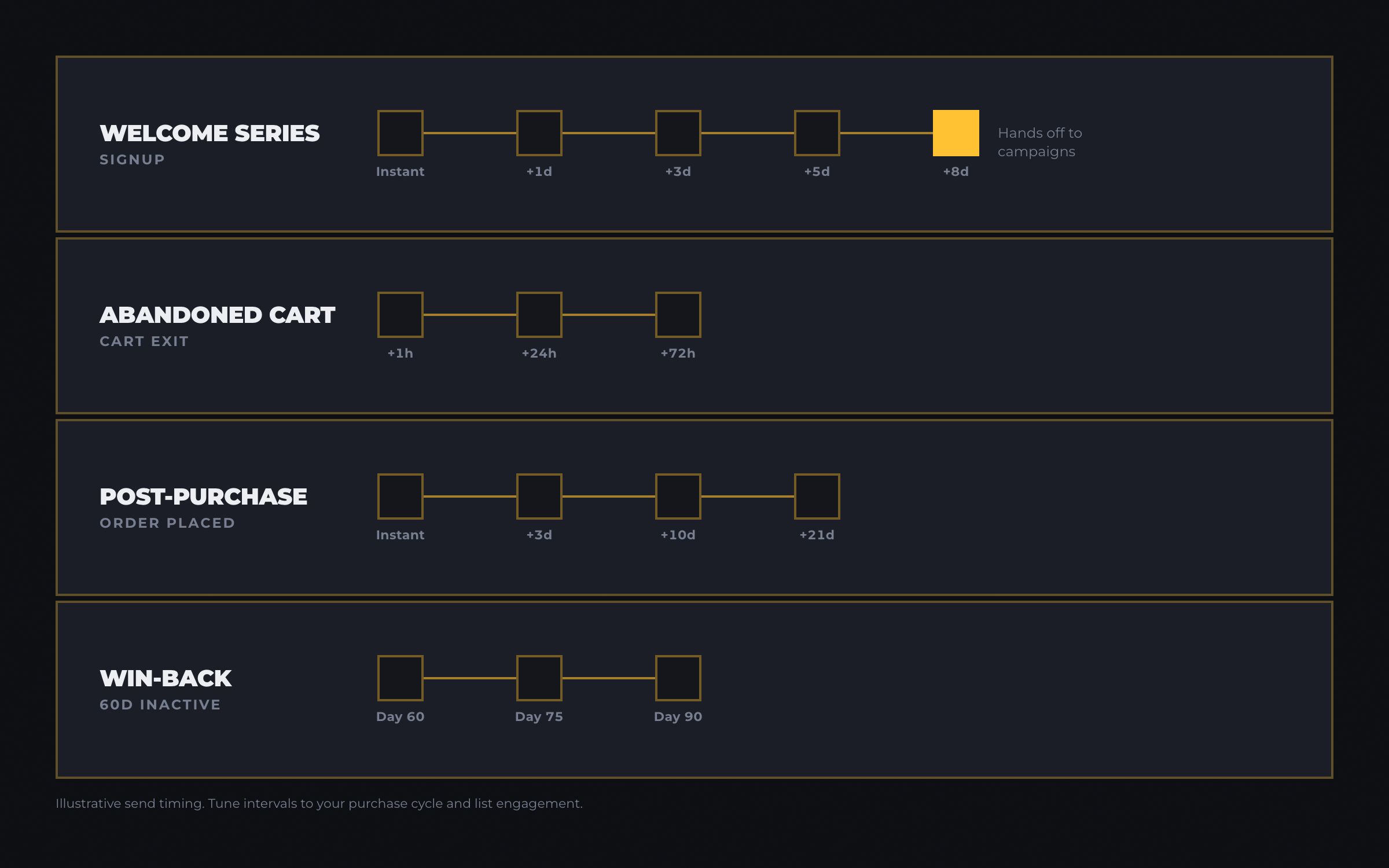
- Welcome series (3 to 5 emails). Introduce the brand story, deliver the signup incentive, and present your bestsellers. Expect a 3 to 8% conversion rate.
- Abandoned cart (2 to 3 emails). First email within the hour, second at 24 hours. Skip the guilt-trip subject lines. Remind them what they left and answer the most common objection.
- Post-purchase (2 to 4 emails). Thank them, set shipping expectations, share usage tips, then ask for a review. This flow builds the repeat-purchase habit.
- Win-back (2 to 3 emails). Target customers quiet for 60 to 90 days with a reason to return. Sometimes a discount. Sometimes a new product.
These four flows, dialed in, out-earn most campaign calendars.
Step 5: Social With Purpose, Not Presence
Posting daily on five platforms with no plan is a fast track to burnout. Focus on one or two platforms where your customers already spend time. For most Shopify brands in 2026: Instagram and TikTok. Higher-ticket or B2B? Add Pinterest or LinkedIn. Social gives your Shopify marketing strategy reach and proof at the same time.
Entertaining content builds awareness. Converting content builds revenue. You need both, and most brands over-index on entertainment because entertainment is more fun to make. Follow an 80/20 split: 80% value (tutorials, behind-the-scenes, customer stories, and UGC) and 20% direct promotion (launches, offers, and drops). The value earns you the right to sell.
One honest tip: if you hate making video, hire someone who doesn't. Short-form video is non-negotiable in 2026. Algorithms reward video, customers expect video, and static posts no longer reach the same audiences.
Step 6: Connect Everything Into One System
Here's where most strategies fall apart. SEO in one silo, ads in another, email somewhere else, social as an afterthought. None of the channels talk to each other.
A connected system looks different. Blog content feeds the social calendar. Social engagement builds retargeting audiences. Paid traffic enters email flows. Email drives repeat purchases, repeat purchases raise lifetime value, and higher lifetime value funds more aggressive acquisition.
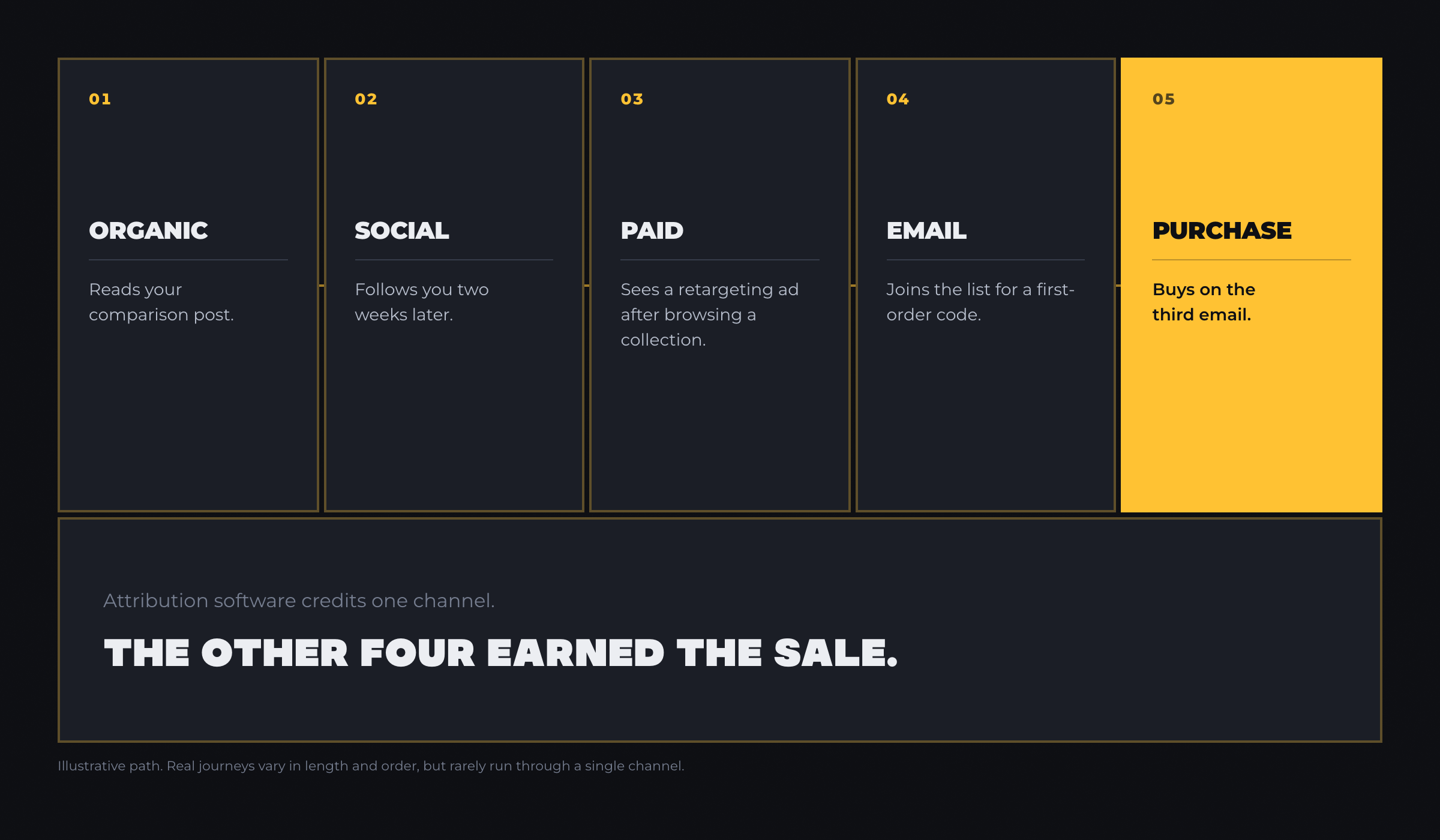
Watch the loop close in real life. A buyer reads your comparison post, follows you on Instagram two weeks later, sees a retargeting ad after browsing a collection page, joins the list for a first-order code, and buys on the third email. Five touchpoints, one system, one customer. Attribution software credits a single channel. The other four earned the sale.
No pipe dream, no exotic tactics. The fastest-growing brands simply make sure every channel feeds the next. A Shopify marketing strategy earns the name when channels stop competing and start compounding.
Start This Week
Your Shopify marketing strategy does not need all six steps live on day one. Start with the foundation. Build the email flows next, because the ROI shows up immediately. Layer in organic and paid as budget allows. Social amplifies everything else.
The biggest mistake? Waiting for perfect. A rough system running today beats a flawless plan living in a Google Doc forever.
Common questions
Shopify Marketing Strategy FAQ
How long does a Shopify marketing strategy take to show results?
Email flows pay off inside 30 days. Paid ads need 60 to 90 days to exit the learning phase and produce reliable numbers. Organic search takes 6 to 12 months. Sequence your build in reverse order of speed. Email first, paid second, organic third.
What should a Shopify marketing strategy cost?
Plan for 10 to 20% of revenue at the $1M to $5M range. A store doing $2M a year spends roughly $16K to $33K a month across ad spend, tools, and people. Ad spend usually takes 60 to 70% of the total.
Should you hire an agency or build in-house?
Below $1M in revenue, most founders run the system themselves with one contractor for creative. Between $1M and $5M, the work outgrows a single operator, and a lean external team beats a full in-house hire on cost. Above $5M, in-house specialists start to pay for themselves.
Which channel comes first?
Email, every time. The list already exists, the buyers already trust you, and the flows run without daily attention. Paid and organic bring new people in. Email turns them into repeat customers.
How often should you revisit the plan?
Review the four core metrics weekly. Revisit channel mix quarterly. Rebuild positioning once a year, or sooner after a major product change.
And if you run a $1M to $5M Shopify brand with a lean team, this system is exactly what we build and operate at Sidekicks: SEO, paid, email, and creative, connected across the full customer journey. Start with a free teardown. We'll audit your store, show you the gaps, and hand you the plan, whether you hire us or not.
Every hero needs a sidekick.
Get the next one in your inbox
We publish guides and playbooks for ecommerce founders who want to know what their marketing is actually doing. No pitch, and you can leave whenever you want.
Subscribe