Menu
Work/
Yoyo's Hotdog
Case study

Sales went up 229 percent on the same hot dog

Two locations, fifteen years of following, and a brand that had come apart into separate pieces. The same hot dog Yoyo's has sold since 2010.

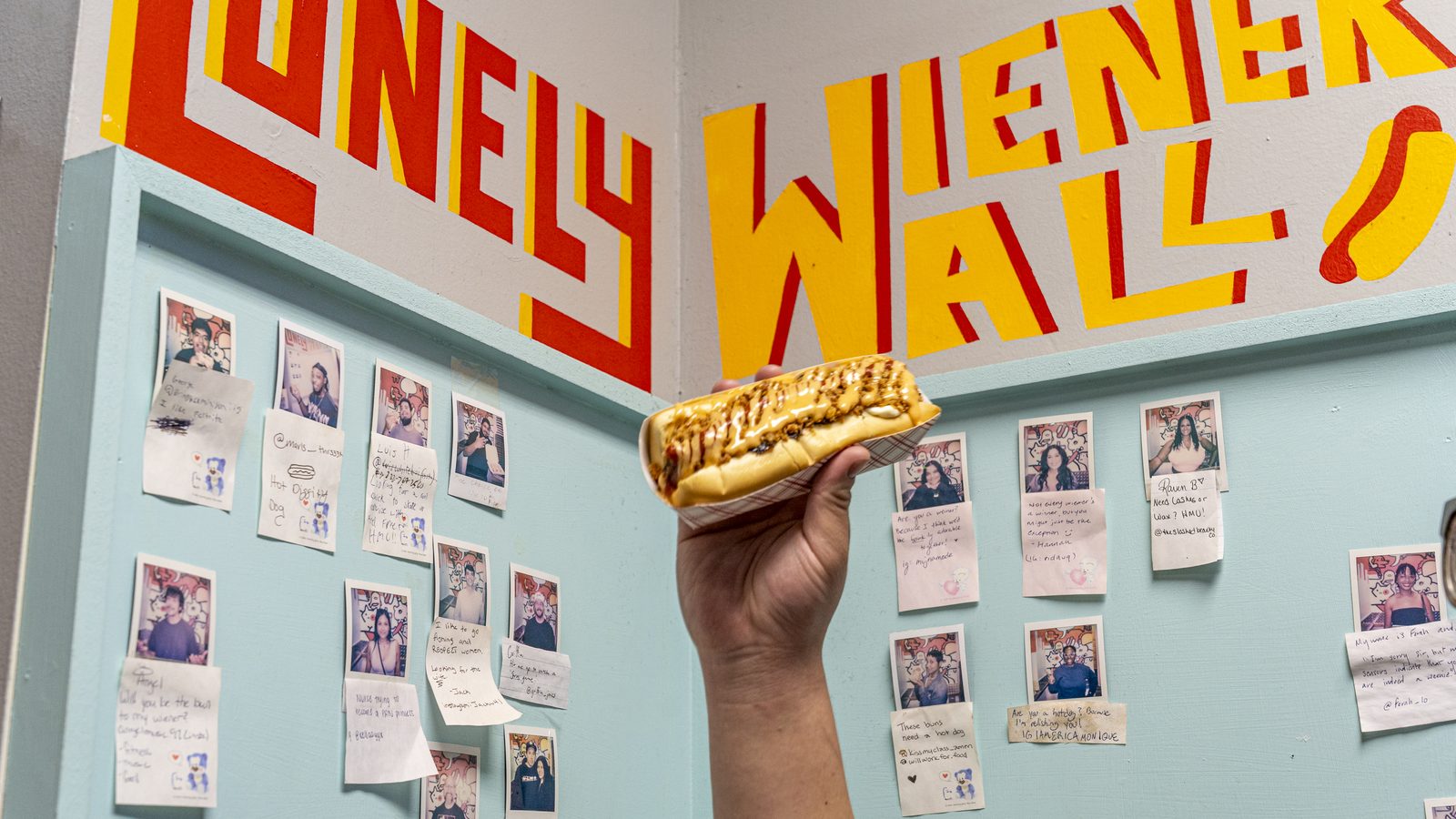
The Lonely Wiener Wall at Yoyo's Hotdog, hand-painted lettering above a wall of Polaroids, with a loaded hot dog held up in front of it
Client
Yoyo's Hotdog
Vertical
Restaurant
Services
Branding
Web
Social
Email
SEO
Headline
229%
On this page
01Where they started
02What we found
03What we did
04What happened
05What did not work
06Where it stands
Read0 / 6
Baseline

Where they started

Yoyo's Hotdog started as a cart in Rice Village in 2010, selling to the crowd coming out of the bars at closing time. There was one hot dog on the cart, Danny Kim made it one way, and that was the whole menu. The late-night line built a following that carried Yoyo's off the cart and into two brick-and-mortar locations.

Fifteen years on, the hot dog was the same and the line was not. Sales had gone flat, and the brand had come apart into pieces somewhere along the way. One logo lived on the signage, a different one on the packaging, and the website looked like it belonged to another business entirely.

Diagnosis

What we found

Danny's son Josh was taking over the business, and he called with a plan considerably bigger than a turnaround. He wanted to franchise Yoyo's, which meant the work had to start somewhere other than where these engagements normally start.

A brand running two different logos across two locations does not survive being copied ten times, and Josh understood that before we had a chance to say it out loud. So the work began underneath, at the level of the system rather than the campaign, and it stayed there for most of the first year.

Josh wanted three things measured. Sales climbing again, the social accounts growing, and more people coming back a second and a third time.

Mechanism

What we did

We started with social content, ahead of the brand work, which is the reverse of how these engagements usually run. A rebrand launched into a quiet account reaches nobody, and Yoyo's account had gone quiet. The first stretch went into rebuilding that audience and finding a posting rhythm that would hold past month three, which is where most restaurant social falls apart.

Josh started showing up on camera himself, and it mattered more than we expected it to. We built the content around nostalgia, because Yoyo's already had fifteen years of it sitting there unused, and the people we most needed to reach were regulars who had fallen out of the habit rather than strangers who had never heard of the place.

The piece that traveled furthest came from something already sitting inside the store. There is a wall covered in Polaroids of couples who met at Yoyo's, and next to it hangs the counterpart, the Lonely Weiner Wall, which is the singles. Both had been up for years and nobody had photographed either one. We built content around both walls, and in April 2026 the Houston Chronicle ran a story on it, Houston's Yoyo's Hot Dog enters matchmaking biz with 'Lonely Weiner Wall', reported by Chyna Blackmon. The coverage came out of something that had been hanging inside that restaurant the entire time, waiting for somebody to point a camera at it.

The brand work came second, once there were people watching again.

Loyalty came third, and it turned into the most interesting problem of the year. Yoyo's runs Square at one location and Toast at the other, which is ordinary for a growing restaurant and a problem for anyone building a rewards program across both. Every platform we looked at handles one or the other, meaning a regular would earn credit at Washington and then walk into the second store as a stranger. That is the wrong experience to hand the customer you are working to keep, so we built the program custom instead.

Car shows came next, hosted at the store. Car culture and late-night hot dogs share more audience in Houston than you would guess, and the shows put real traffic on the property on nights that would otherwise have been dead.

SEO is the phase we are in now, and it is the slowest of the six on purpose. Local search pays off on consistency rather than intensity, and it works better pointed at a brand and a website that are already in order.

Results

What happened

Returning customers
First year
After
Up 300%
Loyalty members
Since launch
After
38,000
Ticket average
First year
After
Up 15%
The honest part

What did not work

The loyalty program cost us most of a quarter before it produced anything. We went through the off-the-shelf platforms first, and every one of them reads Square or Toast rather than both. That constraint was knowable at the start and we did not establish it early enough, so the custom build began later than it should have.

We ran the car shows without putting any measurement around them. We have the content from those days and no attendance figures or same-day sales to sit beside it, which means we cannot tell you whether they were worth repeating. That is our omission rather than the client's, and it is the reason there is no number next to events in the list above.

Catering is the honest gap. The request path is built and it runs end to end, but we have not yet done the work that drives volume into it. It carries better margin than counter service, and a year in it is still the piece with the most room left.

Current state

Where it stands

Yoyo's came out of the year with a brand system instead of a collection of pieces, a website that matches it, a content operation running on a rhythm, and a direct line to 38,000 customers they previously had no way to reach.

Catering now runs end to end without anyone at the store having to start it. A request arrives through the site, an SMS goes back to the customer straight away, and a member of the team is notified to take it over. From that point it is a person rather than a sequence, through to delivery. The path works while the store is closed, which is when a fair number of these requests arrive.

Josh inherited a following and almost no system underneath it. He has one identity now that prints the same at any address, a list of 38,000 customers that belongs to him, and a catering path that answers on its own.

Search is the phase in progress, and it is the slowest of the six on purpose.

Your store, your numbers

Find out what yours is leaving on the table

We go through your store from the outside and come back with the three things costing you the most, with what each one is worth. Two business days, no account access, and the findings are yours whether or not you hire us.