Guide
How to Choose a Marketing Agency
What agencies cost, what falls outside the retainer, and the seven questions to ask before you sign anything.
What agencies cost, what falls outside the retainer, and the seven questions to ask before you sign anything.
Most advice on how to choose a marketing agency tells you to define your goals, build a shortlist, and trust your gut. That's all true, and none of it helps much when you're sitting in front of three proposals with different scopes, different pricing models, and no obvious way to compare them.
So this guide covers the parts the other guides tend to skip: what an agency costs, and what sits outside the retainer and shows up as a change order later. It also covers which size of agency fits the revenue you're doing right now, and what you'll want the contract to say before you sign it.
It's more useful before your first call than after your third.
Write down one number and the date you'd like it moved by. Not "grow the brand," but a number Shopify shows you on a Monday morning. Taking email from $4,000 a month to $12,000 a month by March is specific enough to hire against.
That one number does three jobs at once. It tells you which channel you're hiring for, and it gives every agency the same brief so their proposals become comparable. It also gives both sides a clean way to end things later, without either of you relitigating what the deal was.
If you can't name that number yet, that's fine. Plenty of founders can't on the first pass, and it's usually a sign the reporting is messy rather than the business. Spend a couple of weeks in your own analytics before you start booking calls, because it's the cheapest work you'll do in this whole process. An agency will sell you a retainer while you figure it out, and you'll be paying agency rates for your own discovery.
The number sets your budget too. A channel doing $40,000 a month in revenue won't support a $10,000 a month retainer, so it helps to work backward from what hitting that number is worth to you.
This is the filter most guides leave out, and it'll eliminate more candidates than anything else on this list.
Every agency is built for a revenue band, whether or not they say so out loud. An agency serving $50M brands runs a team structure and a minimum monthly ad budget your business won't support, and you'd end up their smallest and least interesting account. An agency serving local service businesses won't know your platform well enough to help.
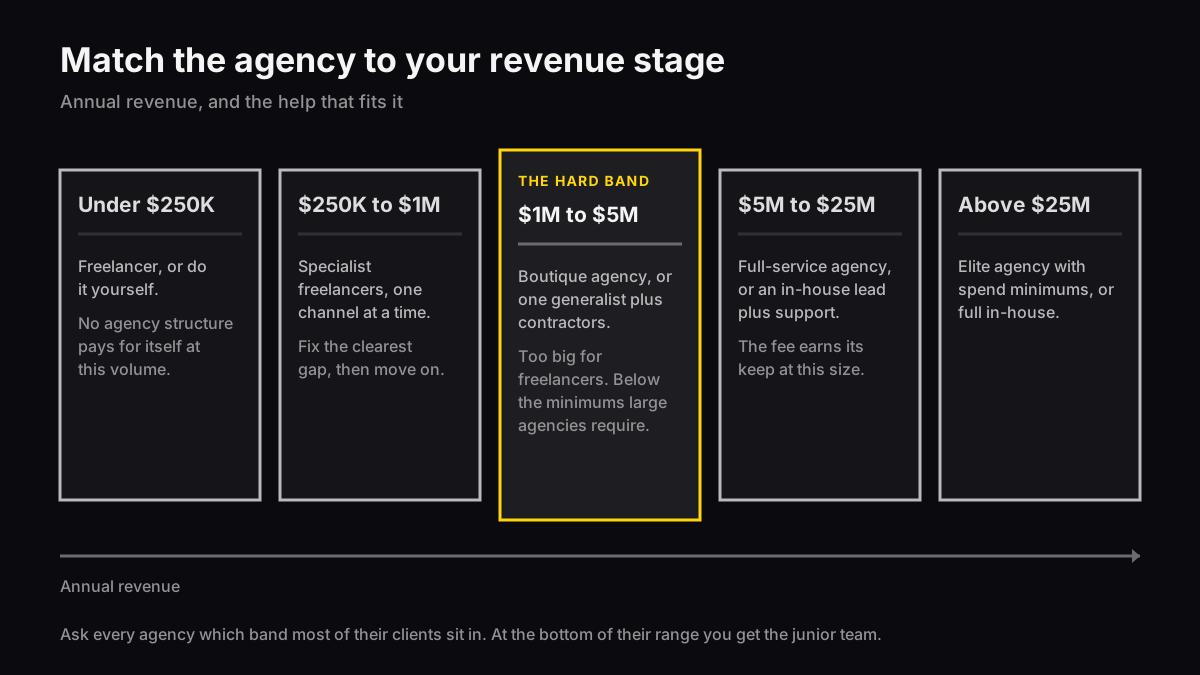
Under $250,000 a year, you're better off with a freelancer or doing it yourself, because no agency structure pays for itself at that volume.
Between $250,000 and $1M, specialist freelancers hired one channel at a time will get you further. Fix the channel with the clearest gap, then move to the next one.
Between $1M and $5M is the hardest band to hire for, and it's where most of the brands we talk to sit. You've outgrown freelancers who need managing, and you're still under the spend minimums the large agencies require. If this is you, a small senior agency or a boutique tends to fit. So does one in-house generalist with contractors behind them.
Between $5M and $25M, a full-service agency starts earning its fee. An in-house lead with agency support for the channels you're missing works as well.
Above $25M you're looking at an elite agency with real spend minimums, or building the team internally.
It's worth asking every agency directly which revenue band most of their clients sit in. At the bottom of their range you'll get their junior team, and at the top you'll outgrow them inside a year. Neither is a disaster, and both are easier to plan for when you know going in.
A ROAS screenshot doesn't tell you much on its own. Platform ROAS is the figure the ad platform reports about itself. It counts the same sale twice when two platforms both claim it, and it ignores everything you spent outside the ad account.
Blended numbers are harder to argue with. Blended CAC is total marketing spend divided by new customers across every channel, and MER, which is total revenue divided by total marketing spend, works the same way. Both are difficult to inflate, because both are built from numbers that show up in your bank account.
Then there's the question underneath those two: what happened to contribution margin? That's the money left from a sale once you've paid for the product, the shipping, and the ads that sold it.
An agency growing revenue while margin falls is spending money you don't get back.
None of this means an agency reporting platform ROAS is doing bad work. It does mean they've picked the one metric they fully control, and you'll want to see the whole-business version alongside it.
It's also fair to ask for a real client report with the name removed. Not a case study, which is marketing, but a monthly report, which is the work product. Most agencies share one, and it tells you more about how they think than any deck will.
Retainer bloat comes from the work sitting next to the scope rather than from the scope itself.
Here's the version we see most often. You sign for email management. Three months in you need product photography for the campaigns, and photography was never part of the deal. Now you're looking at a change order, which is extra work quoted and billed on top of the retainer, or a channel running on stock images.
Nobody's being dishonest when this happens. The scope was narrower than it felt on the call. So before you sign, ask for a written list of what falls outside the retainer. A good agency will have one ready, because they wrote it once and reuse it on every deal. A vague answer usually means you'll be having some version of this conversation every quarter.
Our own pricing page publishes seven exclusions. Original photo and video production, creator sourcing, new channels like TikTok or Amazon, website builds, platform migrations, ad spend and software licenses, and on-site work. You don't have to like our particular list, but you'll want one like it from whoever you hire.
While you're there, ask what a change order costs and how long approval takes, and whether rush work carries a fee. Those questions cost nothing to ask now and a lot to run into three months in.
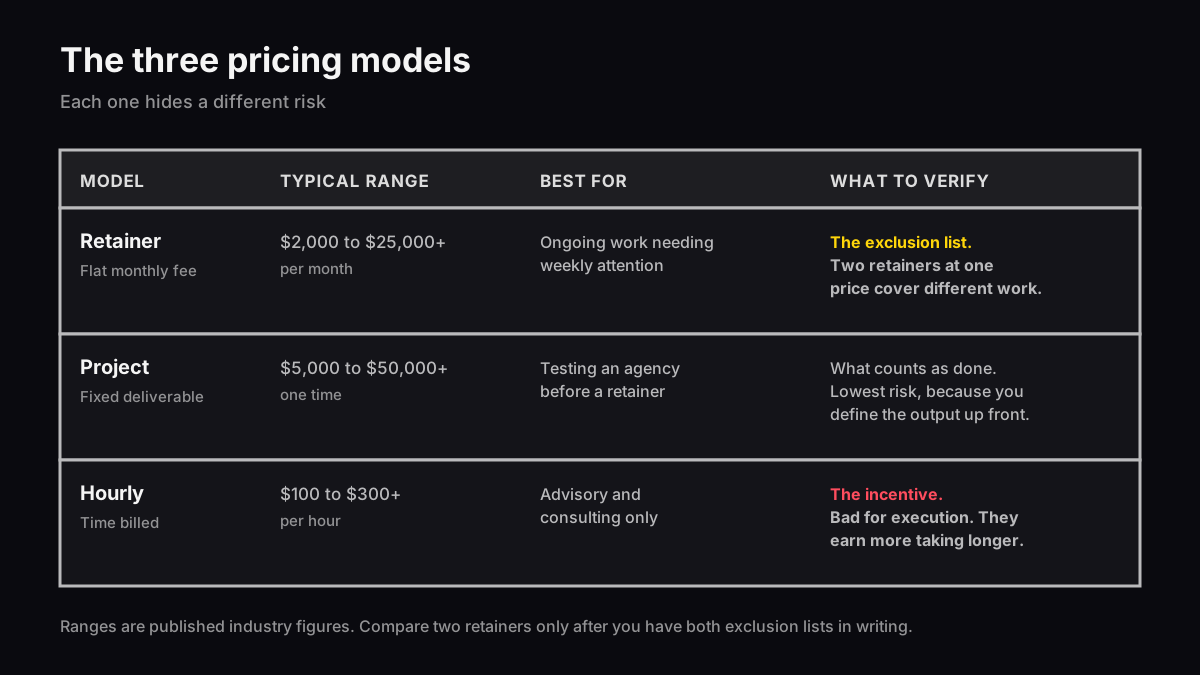
Agencies price three ways, and each one carries a different risk for you.
Retainer. A flat monthly fee for a defined scope. Published industry ranges run from about $2,000 to $25,000 and up per month, which is wide enough to be almost useless on its own. Wait for both exclusion lists before you compare two retainers, because the same price covers a different amount of work at each one. For reference, we publish $1,800 a month for one channel and $3,500 a month for a connected program, each with a setup fee on top.
Project. A fixed price for a fixed deliverable, usually $5,000 to $50,000 and up. The risk sits lower for you here, because you define the output up front. It's a poor fit for anything needing weekly attention, like paid media.
Hourly. Usually $100 to $300 and up per hour. Honest for advisory work, and awkward for execution, because the agency earns more the longer the work takes.
If you're nervous about committing, a short fixed-price project is the cheapest way to find out whether you like working with someone. We run two: a $2,500 diagnostic across all channels in 21 days, and a $2,995 build of a single channel in 28 days. Whoever you're talking to, ask whether they offer something similar, because most agencies confident in the work are happy to sell you a small piece of it first.
These are the questions worth asking on a first call. Whether they have an answer ready usually tells you more than the answer itself.
What number are you accountable for? Listen for a business number with a date attached. A list of deliverables is a different thing.
Who does the work day to day? Listen for names and seniority. If the people pitching you aren't the people delivering, it's reasonable to ask why.
What sits outside the retainer? Listen for a list rather than a reassurance.
Tell me about a client you lost, and why. Listen for a specific, slightly unflattering story. Every agency has lost clients, us included, and the ones who'll tell you about it are usually easier to work with.
What does month one look like, week by week? Listen for setup work rather than campaigns, since a promise of results in week one usually means nobody has been through your account.
What happens if we're behind at 90 days? Listen for a defined checkpoint and an actual decision, rather than reassurance that it'll come good.
Who owns the accounts and the creative if we stop? Listen for "you do." Some agencies run campaigns inside their own ad account and keep the data and the creative when a client leaves, so it's worth confirming ownership in writing.
None of these are automatic disqualifiers. They're the things we'd want explained before signing.
No pricing published anywhere. Common enough, and it does mean the price will depend on what they think you'll pay.
Reporting built on platform ROAS. Covered above, and it's the clearest signal of how an agency thinks about your money.
The pitch team isn't the delivery team. Common, rarely mentioned, and easy to ask about directly.
A twelve-month term with no exit. Agencies do need time to show results, and 90 days is enough of it. Twelve months with no way out is a long time to be committed to something you can't assess yet.
They take you on without asking about margin. An agency that never asks what you make on an order can't tell you whether a campaign is profitable.
Four clauses decide how this ends, and they're worth ten minutes each.
Notice period. Thirty days is normal and sixty is defensible. Ninety with automatic renewal is worth pushing back on, because the renewal date tends to pass while you're still deciding.
Account and asset ownership. Ad accounts, tracking pixels, email lists, creative files, and analytics access should all be yours. Get it in writing, and get admin access on day one rather than during the handover.
Exit terms. What happens to work in progress, whether you get the files, and how long they'll support the transition.
Payment terms. When invoices are due, what a late fee costs, and whether ad spend runs through their card or yours. Spend on their card puts them in the stronger position if things get tense.
The first engagement works as a test with a real decision at the end of it.
Set the baseline before anyone touches anything, and screenshot the numbers you've agreed to move. Agencies inherit trends they didn't create, good and bad, and a baseline keeps both sides out of an argument about what changed.
Start with one channel. Running two at once makes it hard to tell which one did the work.
Ask for the numbers weekly in the same format each time. When a report format keeps changing, it's usually worth asking what the previous one was showing.
Then at 90 days, decide. Did the number move, and did margin hold while it moved? If both are yes, expand the scope. If not, you've got a clean exit and a baseline that explains why, which is a much better position than discovering the same thing at month eleven.
Choosing well takes a few hours of preparation, and getting it wrong costs a year of budget plus a channel you'll then have to rebuild. Most of knowing how to choose a marketing agency comes down to knowing which questions a good one is comfortable answering.
And if you'd like a second read on your own funnel before you talk to anybody, we run a free teardown and send it back in two business days. We publish our pricing in full, and our marketing strategy service starts with the same diagnostic work this guide describes.
Published industry ranges run about $2,000 to $25,000 and up per month for a retainer, $5,000 to $50,000 and up for a fixed project, and $100 to $300 and up per hour for advisory work. Those ranges are wide enough to be almost useless on their own, so it's worth comparing two retainers once you've got both exclusion lists in writing. For reference, we publish $1,800 a month for one channel and $3,500 a month for a connected program, each with a setup fee on top.
Seven of them cover most of the risk. What number are you accountable for. Who does the work day to day. What sits outside the retainer. Tell me about a client you lost and why. What does month one look like week by week. What happens if we're behind at 90 days. Who owns the accounts and the creative if we stop. Whether they've got an answer ready usually tells you more than the answer itself.
Ninety days with a defined checkpoint at the end of it. Agencies do need time to show results, and 90 days is enough of it. A twelve-month term with no exit clause is far more than they need. Set the baseline before anyone touches anything, start with one channel to keep the result readable, then decide at 90 days whether the number moved and whether margin held while it moved.
You should, and you'll want it in writing before you sign. Some agencies run campaigns inside their own ad account and keep the data and the creative when a client leaves. Ad accounts, tracking pixels, email lists, creative files, and analytics access should all be yours. Get admin access on day one rather than during the handover, and check whether ad spend runs through their card or yours.